

Every Instagram account lost followers on May 6, 2026. We checked 100+ accounts and they all dropped by around 2%. Here’s exactly what happened, why Meta did it, and what you should do next.
If you woke up on May 6, 2026 and noticed your follower count was lower, you’re not alone. Your account wasn’t hacked. You didn’t get mass unfollowed. Instagram didn’t punish you for something you posted.
Every single account on the platform lost followers at the same time.
We checked 100+ accounts across every niche, following size, and country. The result? A near-universal drop of approximately 2%. The biggest accounts lost millions. Smaller accounts lost dozens or hundreds. Same percentage, same cause.
Here’s the full breakdown of what happened, why it happened, and what it means for your account.
The Scale of the Drop: Real Numbers
To understand how widespread this is, here’s what we tracked across 10 of Instagram’s most-followed accounts, comparing current follower counts to Google’s cached results:
Instagram Mass Follower Purge
100+ accounts verified · Average drop: ~2%
| Account | Before | After | Lost |
|---|---|---|---|
| @leomessi | 512.5M | 507.7M | -4.8M |
| @selenagomez | 414.3M | 408.8M | -5.5M |
| @arianagrande | 371.4M | 365.8M | -5.6M |
| @kyliejenner | 390.2M | 385.1M | -5.1M |
| @therock | 390.1M | 385.2M | -4.9M |
| @beyonce | 307.2M | 302.8M | -4.4M |
| @lilbieber | 294M | 289M | -5M |
| @davidbeckham | 88.4M | 87.2M | -1.2M |
| @thehughjackman | 33.8M | 33.4M | -0.4M |
| @instagram (official) | 701M | 690.1M | -10.9M |
Real proof: Google cache vs. live count
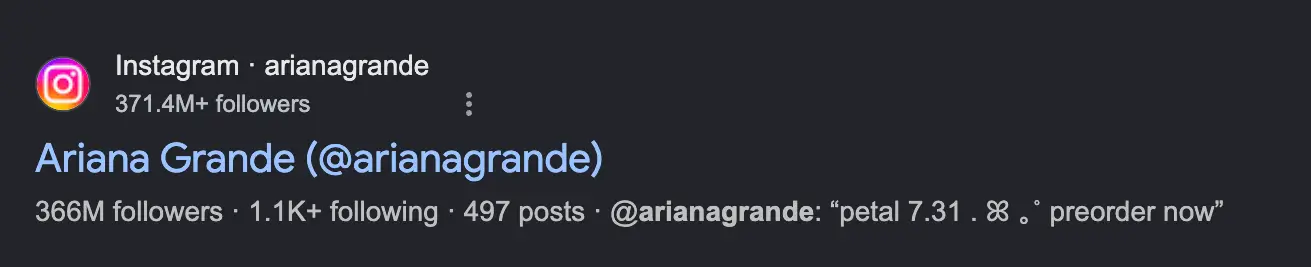
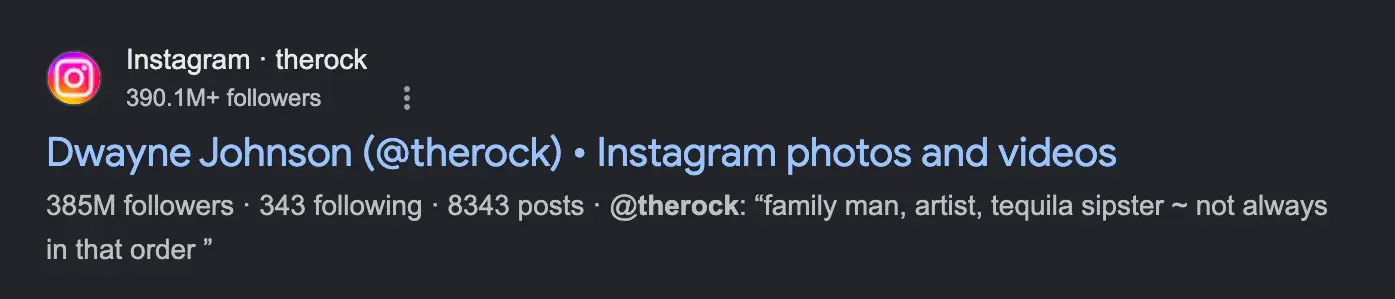
Top line: Google’s cached snippet (old count). Profile description line: current live count.
Source: Google cached counts vs. current profiles · May 6, 2026 · Follovery research
Notice the last row. Instagram’s own official account dropped by 11 million followers. This isn’t a targeted action against specific profiles. This is a platform-wide cleanup, and Instagram itself wasn’t exempt.
Across the 100+ accounts we checked, the average drop was consistently around 1.3% to 2.6%. Small accounts, large accounts, personal profiles, business pages, verified celebrities. It made no difference.
Why Did This Happen? The Real Cause
The timing is no coincidence.
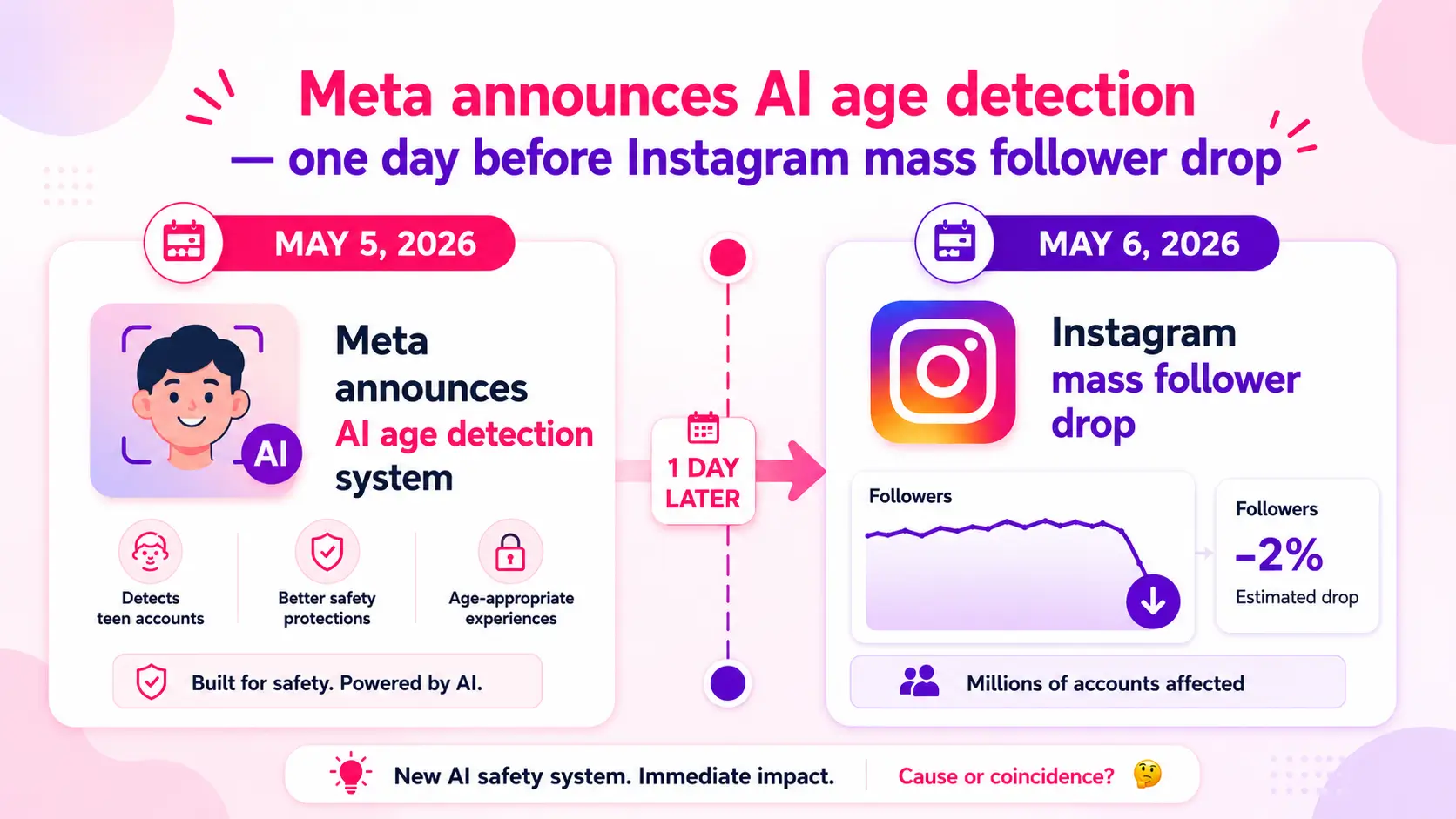
On May 5, 2026 (the day before this mass drop), Meta announced a significant update to its age detection and account enforcement systems. The announcement described a new AI-powered process that scans photos and videos for visual cues such as height and bone structure to estimate whether an account belongs to someone underage.
Under the updated policy, if Meta’s systems flag an account as likely underage, it gets deactivated immediately. The user must then submit proof of age to reactivate the account or it gets permanently deleted.
This was not a new idea. Meta has been under intensifying pressure from regulators on multiple fronts:
- The European Commission had just ruled, in late April 2026, that Meta’s existing age restriction systems were inadequate under the EU’s Digital Services Act (DSA). The ruling demanded stronger enforcement.
- Australia enacted an under-16 social media ban in December 2025. Meta removed approximately 550,000 accounts in that country alone.
- The US state of New Mexico threatened Meta with penalties for failing to keep minors off its platforms, and Meta had to consider pulling its apps from the state entirely.
- Meta’s own Q1 2026 earnings, released April 29, showed its first-ever decline in daily active users across its family of apps. The company is under internal pressure to demonstrate that its user base is clean and credible, not inflated by fake or underage accounts.
What happened on May 6th is the visible result of all of this converging at once. Meta’s new AI detection system ran a large-scale sweep. Accounts flagged as underage, inactive, or violating platform policies were removed in bulk. Every account that had been following real users got stripped away at the same time.
The ~2% average drop across major accounts lines up perfectly with what you’d expect from a platform-wide enforcement action targeting fake, inactive, and underage accounts, which have been estimated to make up between 5% and 15% of Instagram’s total user base.
What This Drop Actually Means for Your Account
Here’s the thing most people get wrong when a mass purge like this happens: they focus on the wrong number.
Your follower count dropped. Your actual audience did not.
The followers who just disappeared were not people who were going to like your posts, buy your products, click your links, or share your content. They were either bots, inactive accounts, underage users who had no meaningful interaction pattern, or fake accounts that had never engaged with anything.
Losing them is, in the long run, a net positive for your account. Here’s why:
Your engagement rate will improve. Instagram’s algorithm measures engagement as a percentage of your followers. If you had 100,000 followers and 1,000 post likes, that’s a 1% engagement rate. If 2,000 of those followers were fake and are now gone, you have 98,000 real followers getting 1,000 likes, so your rate actually goes up slightly. Better engagement rate signals more credibility to the algorithm.
Your analytics become more accurate. Reach, impressions, and demographic data in Instagram Insights will be cleaner. The audience you’re making decisions based on will actually reflect real people.
Your account’s trust signal improves with brands and partners. Agencies and brands doing influencer deals are increasingly using engagement rate and audience quality as their main metrics, not raw follower counts. A slightly smaller but cleaner follower base is worth more in that market.
What To Do Right Now
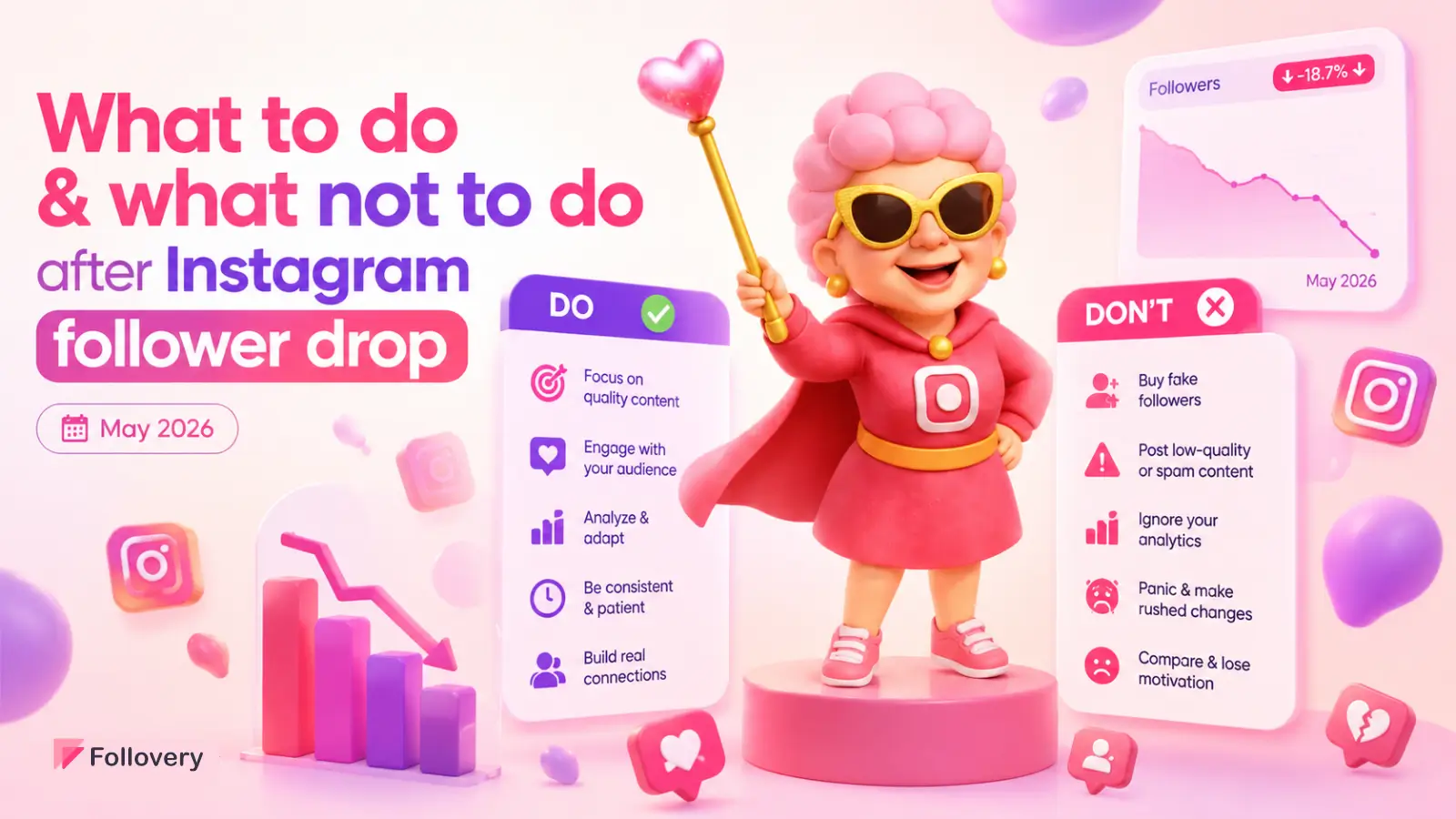
1. Keep posting at your normal cadence. The worst thing you can do is stop. Instagram’s algorithm rewards consistency. A pause signals lower activity at exactly the moment the platform is recalibrating.
2. Check your engagement rate, not just your count. Open your Insights and compare your average likes, comments, and saves per post from last week to this week. If your content is good, those numbers should hold steady or improve.
3. Don’t file a support ticket. This is platform-wide. Instagram isn’t going to manually review or restore followers from a system-wide enforcement action. There’s no appeal process for a mass purge.
4. Let your content do the recovering. Post Stories, Reels, and feed content as usual. Your real followers are still there. The ones who care about what you post will continue engaging, and that engagement will help push your content to new audiences.
5. Review your own follower list if it matters to you. If you’re a brand that cares deeply about your exact count for reporting purposes, this is a good time to do an audit of who’s following you and identify any patterns worth noting.
What NOT To Do
Don’t panic-buy random followers from shady sources. A mass platform cleanup is one of the worst times to add low-quality followers. If Meta’s AI systems just swept through and removed suspected fake accounts, adding more suspicious ones immediately after is asking for further enforcement action.
Don’t change your content strategy. A follower drop caused by a platform enforcement action has nothing to do with your content. Your niche, your posting frequency, your visual style: none of that caused this. Don’t let the number trick you into fixing something that isn’t broken.
Don’t take the count personally. Even Instagram’s own account lost 10.9 million followers in this sweep. David Beckham lost 1.2 million. Selena Gomez lost 5.5 million. This happened to everyone on the platform simultaneously. It is not a reflection of your account’s value.
Don’t wait to see if the numbers come back. They won’t. Removed accounts don’t return. Treat the new number as your baseline and move forward from there.
Will Instagram Do This Again?
Almost certainly yes. And there are now more reasons than ever to expect it to become routine.
It saves Meta real money. Billions of inactive accounts don’t disappear from Meta’s infrastructure just because nobody logs in. Every dead account still stores profile photos, posts, messages, follower graphs, and activity logs across Meta’s servers. At their scale, that is a real and growing cost. Purging accounts that haven’t logged in for years, or that have been flagged as fake, directly reduces storage overhead, database query load, and compute spend. This is operational housekeeping. Meta saves money every time they do it.
Google already proved this playbook works. In late 2023, Google announced it would delete Gmail accounts that had been inactive for more than two years. Millions of old accounts were wiped. The reasoning was identical: inactive accounts are a security liability (easier to compromise and take over), they cost money to store, and keeping them inflates user numbers that no longer reflect reality. Meta is running the same play, just later and at larger scale.
AI makes these sweeps fast and cheap to run. This is the part most people miss. Previously, scanning billions of accounts for underage users, fake profiles, and inauthentic behavior required either huge human moderation teams or blunt rule-based filters that missed most of what they were looking for. Neither worked well at scale. Meta’s current AI infrastructure, the same systems powering its ad targeting, content moderation, and Meta AI tools, can now analyze behavioral patterns, visual signals, and account activity across billions of accounts in hours. The cost of running a purge just dropped dramatically. Expect them to happen more often, not less.
Regulatory pressure is only increasing. The EU’s DSA ruling, Australia’s under-16 ban, New Mexico’s legal threats, and the UK’s Online Safety Act all push in the same direction. Each new regulation gives Meta another reason to run enforcement proactively. And each sweep gives them evidence to show regulators they are taking platform integrity seriously, rather than waiting to be penalized. That is a much better position to be in legally.
The AI age detection system announced May 5th is already active across 28 countries in the EU plus Brazil, and it is still expanding. Expect these cleanups to become a recurring calendar event, most likely quarterly or timed around major regulatory checkpoints, similar to how Google handles its annual core updates.
Think of it that way: disruptive when they happen, predictable once you understand the pattern. The smart move is to build for them, not around them.
The accounts that will grow consistently on Instagram after this are the ones focused on real engagement: genuine content, consistent posting, real community interaction. That’s how it has always worked. The purge just makes the signal cleaner.
The Bottom Line
On May 6, 2026, Meta ran a large-scale account enforcement sweep across Instagram. Triggered by a combination of new EU regulatory requirements, Australia’s teen social media ban, and Meta’s own push to clean up its user data, the sweep removed millions of underage, inactive, and inauthentic accounts simultaneously.
The result: every account on Instagram lost roughly 2% of its followers overnight. Accounts with 10 million followers lost around 200,000. Accounts with 100,000 followers lost around 2,000. Even Instagram’s own official account lost nearly 11 million.
Your account is fine. Your content is fine. Your real audience is still there.
Focus on engagement, not the count. That’s the metric that determines your reach, your visibility, and your growth from here.
If you’re looking to keep your content performing strongly during this transition, consistent engagement signals matter more than ever. Follovery’s auto-likes and auto-views keep your posts in momentum with every upload, so the algorithm sees activity even while counts settle. Starts from $0.003 per like, no password required.

Professional content creator and Instagram growth expert.