
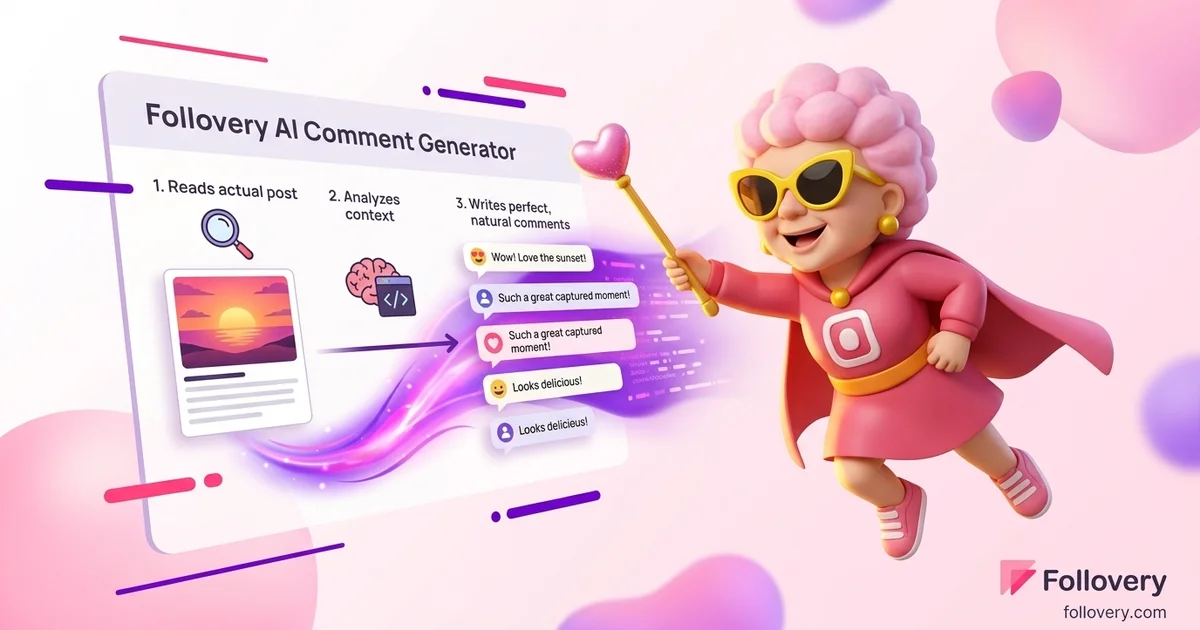

We built a free tool that reads your actual post before writing comments. Here’s why that distinction matters more than it sounds.
There’s a dirty secret about most AI Instagram tools: they don’t actually look at your post.
You paste in a URL or type in a caption, and they spit out 10 comments that could go under literally any photo ever uploaded to Instagram. “Love this! 🔥” “Such great content!” “Amazing shot, keep it up!”
These aren’t comments. They’re confetti — colourful, vaguely celebratory, and entirely meaningless.
We built the Follovery Instagram Comments Generator to solve this specific problem. It’s free, requires no sign-up, and works differently from every other tool in the category. Here’s the full story — why we built it, what we changed technically, and what we learned about building free AI tools as a growth strategy.
The Problem Nobody Talks About
Instagram engagement tools have existed for years. Comment generators specifically have been around since at least 2019. And almost all of them work the same way: you give them a caption or a topic, they run it through a text model, and they return generic engagement-flavoured phrases.
The reason is simple: it’s cheaper. Text-only processing costs less than multimodal inference. Most teams building these tools optimise for cost, not quality, and they assume users won’t notice the difference.
But users do notice. The moment you drop an AI-generated comment under a post of someone’s new puppy and it says “Great perspective! Very thought-provoking”, you’ve done more damage to your engagement strategy than doing nothing at all.
The problem isn’t AI — it’s AI that hasn’t looked at what it’s commenting on.
What We Actually Built
Our generator does one thing differently: before writing a single comment, it fetches your actual post.
Give it an Instagram username or a direct post URL, and the tool retrieves the real image and caption. That content — the photo itself, not just text metadata — is passed to a multimodal language model that can see what it’s looking at before it starts writing.
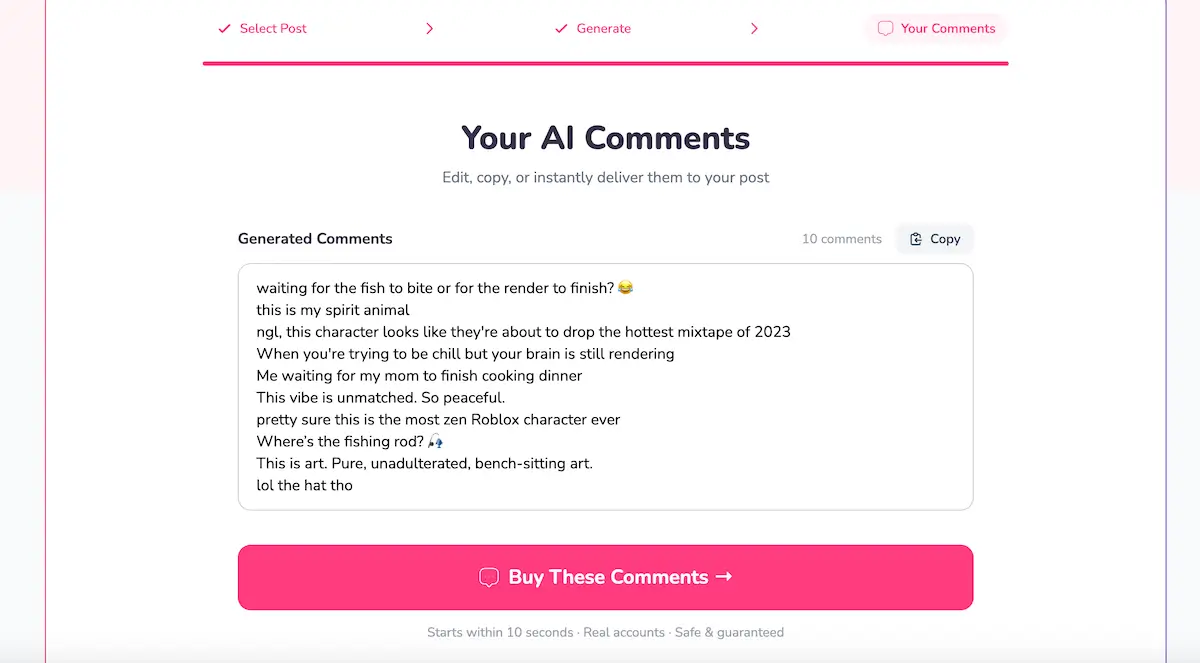
The result is comments that are post-specific. If you upload a flat-lay photo of a new skincare routine with a caption about your morning ritual, you get comments referencing the products, the aesthetic, the routine — not a generic “Love the vibe!” that could have been generated from a blank page.
We also added tone selection — Hype, Friendly, Funny, Flirty, and Professional — because the same post needs different comment energy depending on your brand voice. A skincare brand and a streetwear label both need comments that feel on-brand, not identical.

Why We Made It Free
This is the part most companies don’t say out loud: the free tool isn’t an act of generosity. It’s a growth mechanism.
Follovery’s core business is Instagram growth services — buying likes, followers, comments, and views. That’s a market with a lot of noise and a lot of trust problems. Every competitor promises real accounts, fast delivery, safe growth. Standing out on those claims alone is nearly impossible.
A free tool changes the dynamic. Instead of asking someone to trust us with their Instagram account and their money, we ask them to try something that costs them nothing. They get value immediately — 10 genuine, post-specific comments in under 10 seconds — and in exchange, they experience what Follovery’s AI actually does before deciding whether to buy anything.
It’s a sampling strategy, not a charity one. And it happens to be useful enough to stand alone.
What Surprised Us After Launch
A few things we didn’t expect:
The tone selector became the most-used feature. We thought users would mainly care about volume — how many comments they could generate. Instead, the tone filter got clicked in the 82% of sessions. People wanted comments that matched their voice, not just comments that existed.
Users edited heavily. The generator produces up to 100 comments, and 70% of users edited at least some of them before copying or ordering. That’s actually a good sign — it means the output was close enough to be worth refining, rather than being discarded entirely. A comment that gets edited and used is a better outcome than a perfect comment that gets ignored.
The “no sign-up” decision reduced friction more than we expected. We debated whether to require an email. The logic for requiring one was obvious — grow the list, build retargeting audiences, track attribution. We decided against it for the launch. The drop-off between landing page and first comment generation was lower than anything we’d seen on gated tools. People try things they don’t have to commit to. That’s just human nature.
The Bigger Point About Free AI Tools
There’s a pattern emerging among SaaS companies building free AI tools as acquisition channels. Ahrefs has free SEO tools. Canva built its empire partly on a free tier that converts to paid over time. HubSpot’s free CRM has been their most effective sales tool for years.
The playbook is the same: make something genuinely useful, let people experience it without commitment, and trust that a percentage of them will want more.
For a company in the Instagram growth space, where the dominant marketing move is paid ads and influencer deals, a useful free tool is a rare differentiator. It generates organic search traffic, earns backlinks naturally, and builds trust in a category where trust is scarce.
The Instagram Comments Generator isn’t going to replace our paid services. But every user who gets 50 good comments out of it for free and then wonders whether those comments could be delivered to their actual post — that’s the funnel working exactly as intended.
Try It
The generator is live at follovery.com/instagram-comment-generator — free, no account required. Paste in a username or a post link, pick your tone, and see what happens when the AI actually looks at your content first.
If you’re building something in the AI tools space and want to compare notes on the free-tool-as-growth-channel strategy, I’m genuinely interested in that conversation — find me through the site.
Follovery provides Instagram growth services including a free AI-powered Instagram Comments Generator. This article was written by the Follovery team.
On the Technical Side: Why Multimodal Matters
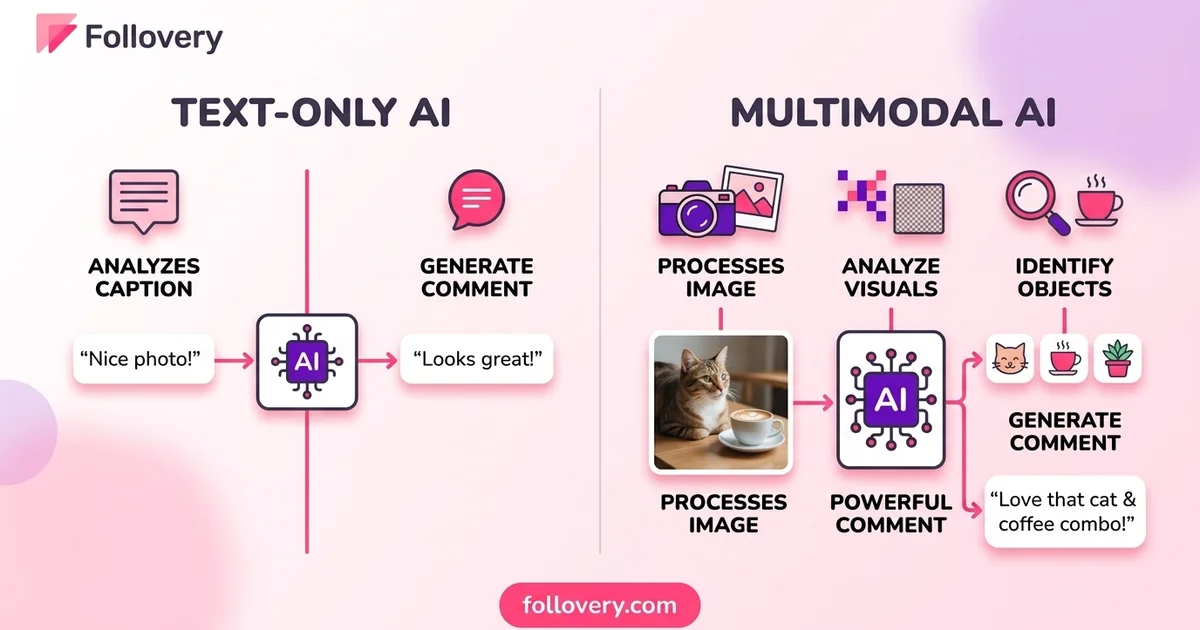
For anyone curious about the mechanics: the generator uses a vision-capable language model — the kind that can process image data alongside text, not just read a caption that describes the image.
The difference sounds subtle. In practice, it’s significant.
A text-only model working from a caption like “Morning routine ft. my new SPF 🌞” will produce comments about routines and sunscreen. A multimodal model looking at the actual flat-lay photo will notice the specific product placement, the colour palette, the aesthetic choices, the way the products are arranged — and write comments that reference the image as a whole, not just the words describing it.
This matters because Instagram is fundamentally a visual platform. The image is the primary content. The caption is context. Tools that process only the caption are reading the footnotes and ignoring the book.
We’re not the first to apply multimodal AI to social media tools — but we may be the first to make it free and accessible without requiring an account or a credit card.
What We’d Do Differently
If we were starting over, one thing we’d change: we’d instrument earlier.
We launched the tool before we had clean attribution tracking in place between the generator and our paid services. We know the generator drives traffic. We don’t yet have clean data on exactly what percentage of users convert to paid customers, or at what time lag. That gap makes it harder to justify further investment in the tool internally, even when anecdotal signals are positive.
The lesson: if you’re building a free tool as a growth channel, treat the analytics stack as part of the launch, not an afterthought. Know from day one how you’ll measure whether the strategy is working.
The second thing: we’d write the content strategy before launch, not after. The generator is a natural subject for articles, comparisons, and “best tools” roundups — but most of those opportunities require us to pitch proactively. Starting that process at launch rather than post-launch would have compressed the timeline to organic traction.
Both mistakes are recoverable. We’re recovering from them now. But if you’re planning something similar, front-loading the measurement and distribution work will save you weeks.

Professional content creator and Instagram growth expert.